

Roll over, Olias, and welcome (back) to a world rich in prog fantasy, instrumentally lavish, if also with narrative, from The Trouble Notes.

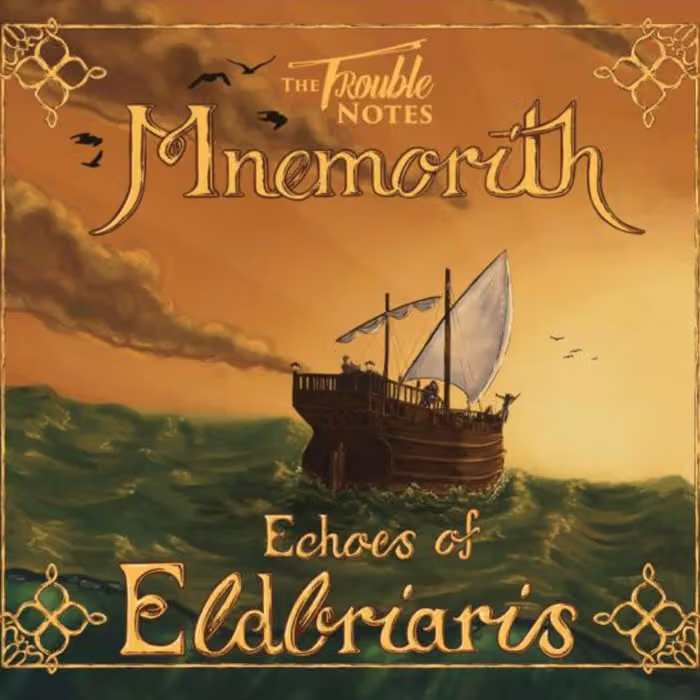
Blimey….
…..awaking all hobbits, that’s one heck of an album title and album cover! Bringing forth all manner of Proustian rushes, it is resonant and redolent of Jon Anderson at his winsome faerie peak! Surely, surely this is prog, and, no, you wouldn’t be far wrong, if firmly cross-referenced into the folkier margins thereof. A Roger Dean commission and it would be perfect.
WHAT THE FOLK?
The Trouble Notes are a trio and have never been easy to classify, let alone quantify. Based on bookings, they being a popular feature at, nominally, folk festivals, here they deliver a set as far from the F word as fiddle, guitars and drums can go. An American, a Brit and a German, coming together originally via individual busking exploits across the UK and Europe, a triggering influence was the experience and journey of Rodrigo Y Gabriela. Best known of the three is likely Bennet Cerven, the livewire dervish, who added so much to the spectacle of Steve Knightley’s short-lived Dream In Colours project. When that went south, I dare say Cerven’s two buddies breathed a sigh of relief.
LUSTROUS & LARGELY INSTRUMENTAL
This is ambitious. Mnemorith translates loosely to streams of memory, the name here to represent an island, the design being to tell of ancient quasi-Celtic mythologies therefrom. As a result, alongside the seven lustrous and largely instrumental tracks, there are six of narration, sometimes quite lengthy, probably important as in integral, but needing some preparation and that warning. Aiding and abetting the threesome, there are a welter of guests scattered across the tracks, to expand the palate and enhance the tale’s telling.
A FLORID & DISCIPLINED REEL
A ponderous drum beat opens the intro, Echoes Of Eldbriaris, ahead some power chordage that feeds into the soaring electric violin of Cerven. (I hesitate to reference it as fiddle, as may become apparent.) Those initial few bars then pause, taking stock and allowing the music to break into a florid, yet disciplined reel. Folk as in folk-rock and more rock than folk, with echoes of String Driven Thing rather than Fairport. The drums of George Bingham are a solid metronome, with enough imagination to keep in interesting, whilst, in appearance only, the acoustic guitar of Florian Eisenscmidt is anything but, amped up with appropriate vim to satisfy any metalhead.
10 minutes of cod-Tolkien talk follows, which either adds to the appeal or strains any patience for such whimsy. Cerven is the narrator, and, with his transatlantic twang, it is no worse, or better, than you might imagine. Personally not my bag, so I was ready then for So We Dance. An acoustic ballad, it features singing, this also coming from Cerven, whose voice is much as you might anticipate from his spoken tones. Pop-folk of the sort that Renaissance used to ply, it is the instrumental sections that carry the greater heft. Luna Schmid, Tobias Joppen and Jakob Hofmann of German folk/dance band, Reikas Tanz, add hurdy gurdy, nyckelharpa, bouzouki and the like, with additional vocals from Hannah Jo McKinlay. A tad underwhelming, if I am honest, however sweet the violin solo actually is.
GABRIEL TERRITORY
Following another prolonged exposition, things take a huge upturn for the better, for No Land In Sight, a dense arabesque of picked guitar and hand percussion. This instrumental combination works well, not least with the underlying rumble of bass, also from Bingham. There are vocals, again, which, after some amplified slashes of guitar, see Cerven embarking, vocally, into Gabriel territory, jumping to an accent fitting to the lyric. Picking up his instrument, Cerven and co. then hit a very satisfactory groove. Some choral vocals, McKinlay again, and Maria Vesta, enter, as it switches key into a more comfortable minor, and I am beginning to get it. In fact, I rather like this bit.
Benni Cellini is a cellist and the next guest, and the tune within which he features, is a tremendous stop-start polyrhythmic Tourette of a construction, Storm Searching. The cello chops and the violin sweeps, with an emphatic drumbeat from Bingham conveying a sense of riffage, to which Eisenscmidt adds all manner of guitar parts, hard slams and trebly solos both. If you have got this far I would say this is where it all comes together. It is also more in styles that previous excursions of the band have always excelled at. I didn’t want it to end.
CLASSICAL ROCK FUSION BANGER
With the talkie bits now generally shorter, it is less of a haul to The Abyss, which is gothic metal that starts in a chant mode, like a mystic ceremony. The fiddle goes all delightfully weird on is and it is another keeper, as Vesta keens eerily from the sidelines, all very Vox Bulgare. A central section is more reflective, as Cerven drops into a croon before it dials out. Solospire, which kicks up after the shortest of the narrative spots, is one of those Violinski style classical rock fusion bangers once so popular, and done, dare I say, rather well, the ensemble really cooking. Heck, even the choral vocals can’t take that away, and the boy Cerven can really play. It’s even quite a catchy earworm.
Those offended by any perceived snarks in this review, may possibly be aware of the accompanying book to the recording, a lavish tome, which fills in the dimensions missing from a purely aural reception. Had that been available, I am guessing, and hoping, a greater sense may have been made of it all. Cerven has the opportunity therein to more fully explain his inspiration, and does. The illustrations, a collaboration between Samanta Scherer and Alina Clever, alone are described as divine. Indeed, it is all pitched, on Bandcamp, as a book with an accompanying CD, rather than vice versa.
ETHEREAL BUILD
But we aren’t done yet with the music, as there is one final opus, Virexium, which dabbles in all the styles thus far, starting acoustically and ethereally, building up steam over a number of iterative rhythm motifs. An instrumental epilogue, it is a good overview of what the band are capable of, and had me thinking about some of the similar wide-screen sonic of Talisk.
So, a bit like Topsy, this is a a generally good album, a very good album in parts, if flawed by the overgenerous propagation into avenues less well trodden. As said, very ambitious, and when it works, tremendous. How often it will get listened to, start to finish, I don’t know, that perhaps dependent on the tolerance for spoken word, or, maybe, just having access to the book. I am uncertain around whether there are plans to present it as a show? That might work, I guess, for lovers of Middle-Earth. Me, I’m going to fillet the filler out and play the music.
Here’s the instrumental heart of the album, Storm Searching:

The Trouble Notes: Website