


A new name and voice to savour in Gaelic song, and sufficient to stand out proud from the competition.

FROM ISLAY PEAT…..
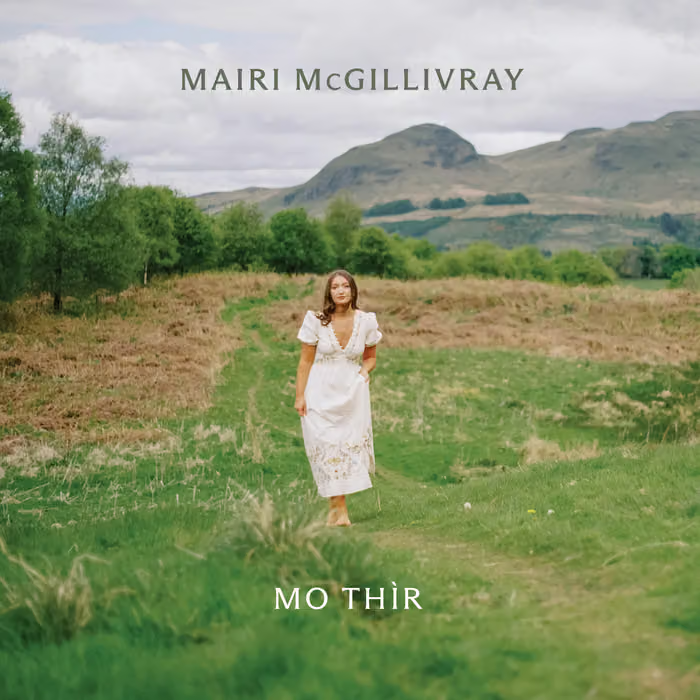
So, we have featured singers from Lewis, from Skye, Tiree, the Uists and further, each and every of the Hebrides, inner and outer, a potent breeding ground for musical talent. But have we had any from Islay? Forgiving the likes of Norman Macleod, not, it seems, for a while. Young Ms. McGillivray is set to break any perceived drought, with this, her first full-length release. A Danny Kyle Award winner in 2021, the accolade bestowed on the best of the newest up and coming talent at the prestigious Celtic Connections Festival, she was also a finalist in the BBC Radio Scotland Young Traditional Musician of the Year competition of 2023. As the title of the album might suggest, her field is that of, predominantly, Gaelic song. And rather than anything maternal, Mo Thìr means my land, or my country. (Motherland?)
PURITY OF VOCALS, DELICACY OF ARRANGEMENT
Here there are ten tracks, with all but two in her own tongue, two in the English thrown in for good measure. They are all a mix of those drawn from the tradition and penned more recently, including two of her own. Isla Callister, Seán Gray, Ewan Baird, Charlie Stewart and John Lowrie provide sensitive backing, on, variously, fiddle, guitar, keyboards bass and percussion. Doyenne of Gaelic song, Kathleen MacInnes, also guests on one track. Carefully produced by John Lowrie, whose name we best know from Staran, the way the purity of the vocal is matched to the delicate orchestration is powerfully gentle on the ear, without any abrasiveness or shrill edges creeping in, a risk occasional with this sort of material.
THE SPRAY OF SURROUNDING SEA
It is with the driving sea-swept rhythms of ‘S Mòr No Churam that the album opens. A tale set in a maritime storm, it tells of the final wishes of the sailor, for a letter to his love be able to get to his beloved, back home on Islay. Century’s old, the band deliver it a stunning backdrop, with Baird’s galloping bodhran and McAllister’s fiddle vying over Lowrie’s piano, all evoking the wild waves. Soaring above, McGillivray’s vocal is the spray of the surrounding sea. It’s lovely, and sets the stage well, shaking away any cobwebs inadvertently stored in the file marked trad.arr.
Picked guitar from Gray meets with a shimmer of only just organ and rippling piano, for A Mhic an Tòisich, ’s Ceanalt’ Thu, with McGillivray again flying over the arrangement. McAllister comes back in for an instrumental break that is, too, full of salt and soul, and is as rich as the voice that precedes. Listen carefully, and Stewart, known mostly elsewhere as a fiddler, is applying some nuanced double bass patterns. Next up is Buain a’ Choirce which has the ring and cadence of a puirt à beul, to appease those who insist on such in their Gaelic fare. Again, it is the piano and fiddle that set it apart.
SORROW SEEPING THROUGH EVERY NOTE
If that last one suggested wholesome, gainsome activity, Ceann Tràigh Ghruinneart is the complete opposite, a bleak lament, with sorrow seeping through every note. Lowrie drops notes like tears, as McGillivray pairs with MacInnes for each gaunt chorus. Eerie fiddle scrapes evocatively and it is hard to consider doing anything else than listen with other than full attention and absorption. The two voices are quite different, MacInnes offering a gentler perspective to the abject grief of the younger singer, the harmony as sharp as a blade. A song in honour of Sir Lachlan MacLean of Duart, who was killed in the battle of Gruinart Strand, on Islay, in 1598. A skirmish between Clan Donald and Clan McLean. MacLean was apparently killed by an arrow fired by a dwarf known as Dubh Sith, the Black Fairy, and, once again, I am wishing my Gaelic Duolingo was up to date.
Ach a Dhòmhnaill Òig Ghaolaich is a spikier piece, over edgy guitar syncopations and a tapping beat. This is a waulking song that benefits well from this atypical arrangement, not much like the Capercaillie version, if still clearly the same source. And if we are going to reference the peer group of likely influences, cast a thought for Runrig, for it is their song, Eirinn, that follows. Stripped of the electric armamentarium of the Scottish Band, the version here might have you checking the credits for the original, so steeped in a long gone past does it sound. Possibly the simplest arrangement here, little more than skeletal guitar, piano and fiddle, it is amongst the best.
A SWEET SONG TO COVER
Another cover follows, and the first song not in Gaelic, Dougie MacLean’s wistful This Love Will Carry. A staple of any of his live shows, and, in that setting, with the audience often picking up much the heavy lifting, it is a gorgeous song. Oddly, in this context and setting it doesn’t quite work, being just a little too sweet. I’m trying to accommodate my view, it being a song I value, but it is an outlier here. Too obvious a choice, maybe, shoehorned in for a wider audience. I’ll bet it is still the song they will play on the radio.
I think Ameireaga is one of the two McGillivray own compositions; at least, I can find no other links to it, as a song title. In a similar vein to the earlier Buain a’ Choirce, here is again a song I would relish a translation of. Is it a song of the clearances and deportation or a critique of a fellow islander, in part, by blood? I know one of her songs was inspired by the Islay bard, William Livingston, I suspecting it this. I think it says something about this album, as I am normally content to just hear the sounds in non-anglophone song, as just another instrument. Here I want more. This is, I guess, delivered by Starlings, the second song in English, as well as, I think, her second self-written. A lingering love song of sorts, it floats imaginatively, the soundtrack to a slo-mo murmuration.
LOVELORN LONELINESS
Mo Ghaol Òigfhear closes the album, and is a further keening call from the Islands, this time from St Kilda, a siren’s moan for a lover, far away on Islay. Gray’s guitar sounds like a harp and McGillivray sounds bereft. It is a haunting and daunting listen, encapsulating the sense of lovelorn loneliness across a treeless landscape, battered by elements both real and imaginary. Lowrie gradually stirs in some unsettling patterns just towards the end, and then it is all gone, the glimpse of a rainbow lost in darkness.
QUEEN OF THE GLUT?
There seems no shortage in Highland and Island singers of this calibre at the moment, which is a tough field for McGillivray to stand out in. However, by virtue of this record, and the lustrous scaffolding built about her pristine tones, I would suggest this will be far the last we hear from her.
Here is the first track, ‘S Mòr No Churam:

Mairi McGillivray: Website