
Are you sitting comfortably? Wild Gods wreak havoc and make hay with the tradition. More glorious than abysmal.
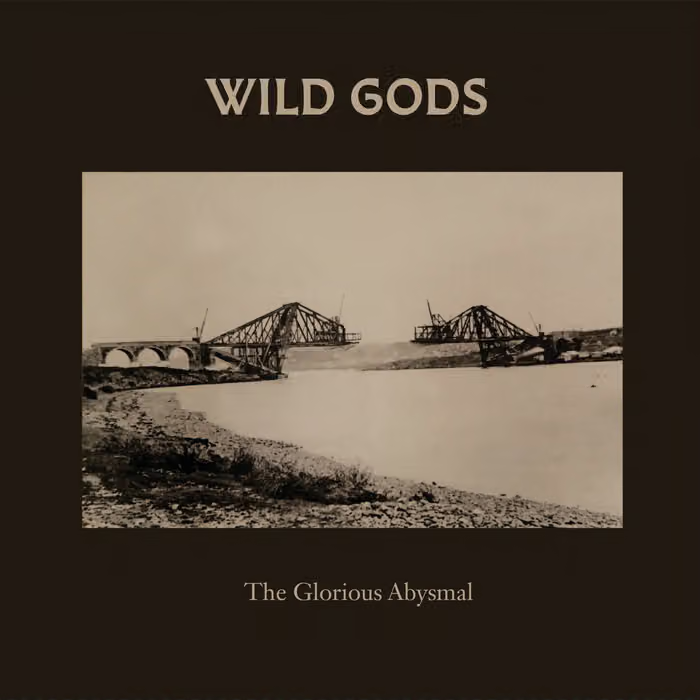
FILE UNDER FEARLESS
If you love a side-order of atmosphere locked into your listening pleasure, this might be just the ticket, as, over barely 30 minutes, this collective of Celts apply lashings of a drench, dank drizzle over stark Hebridean landscapes, by way of tapes, drones and motorik bass. Yes there are fiddles aplenty as well, Gaelic singing, and even a brief entrée of pipes, but this is definitely not file under folk territory.
Wild Gods are the brainchild of Jamie Livingstone. Making music “born from Celtic ceremonial sounds, sampled Gàidhlig archival material and Empyrean noise“, that is their own description, and it is a good one. Enrolling a loose collective of collaboratees, it is less daunting than either he or I make it sound. Surprisingly accessible is what I see I have jotted down.
SEPULCHRAL LAMENT
Keening is described as a loud, long, and high-pitched wail or cry. It is most often performed as a traditional vocal lament to mourn someone who has died, especially in the Gaelic diaspora. It is also the name of the opening track here. It begins with sampled distant voices, principally that of Madge Bray, doing just that, keening, with a sepulchrally distant bagpipe drone. Deliciously eerie, it conjures up all manner of distant spirits. The drone fades and a doomy chord clangs, with a bass guitar running up and down a scale.
Some captured chatter and suddenly there is a voice, singing gently in the Gaelic, as fiddles saw a sombre backdrop. The melody is intrinsically Gaelic, the arrangement something more industrial. A spiky riff repeats and the strings soar. The percussion is dense, the bass deeper. This is Carlene and she’s worth the meeting. An accordion, or is it harmonium, wheezes and the mix of ancient and modern meets in a middle distance. I’m in, and it is nine minutes of drifting dystopia, owing more to metal than Mànran.
So who’s who? Jamie Livingstone apart, who writes and plays guitar, keys, drums and whatever else is needed. The singer is Susannah Stark, who also plays harmonium. The bass comes from Niall MacDonald, aka Blackboxx, with various fiddle parts coming from Cait O’Neill and Maria Zhuravlova. Each all contribute to composition. There are others, but I sense these the principal players.
HAUNTED & FRACTURED
A palate cleanser follows, with chiming electronic notes. Named Cainntearachd, fans of Brighde Chaimbeul will know this as the an ancient method of chanting, teaching, and memorizing the tunes of the highland bagpipe, here in, I guess, a modern interpretation. But it does the trick, allowing new and cleansed ears to the more appreciate Rest And Be Thankful, which starts with what sounds to be an extended church organ drone with guitar and bass idling alongside. A far off voice introduces himself before, again, female vocals.
The voice now seems different, more haunted and fractured, suggesting maybe this is now O’Neill, possibly just a reflection of Stark’s range; she has a extensive background in experimental post-folk fusion, and I wouldn’t put it past her. This time the lyric is in English, principally repeating the title, Rest And Be Thankful, and the discordant folk-rock distort is dialled up, in well balanced quiet/loud/quiet/loud, where the fiddle is unctuous and sticky.
HYPNOTIC PRECISION
Time for another breather, with Ortha, the name of a Goddess, a brief ethereal tingle of synths, ahead resuming the aural assault with Hilma Of Klimt. No, me neither, but apparently a Swedish artist and mystic, so obviously within Livingstone’s extensive library of reference. A moodier piece, the vocals, and I’ll assume Stark, near chant over a slow guitar motif, into which the bubble of an incoming tide begins, with almost motorik precision from the rhythm section. It builds hypnotically before your ears, ahead drifting back. Disembodied voices drop in and out, without any loss of the then again forwardly driven momentum. Well spooty, even as it implodes to a close.
Aye, Right, the title of the last piece, may well be Livingstone’s response to the sort of burbling critique, like this, his work inspires, but, as a track/tune, it acts more as a soothing epitaph, or eulogy even, calming-ish instrumentation, that leaves enough of a question mark to have you need to play it all again. The keening choir are back, as if heard through a fever dream. And then you wake.
MAGNETIC NORTH
Music like this you will either love or hate, often simultaneously, but hopefully more the former, the compass open to changing with any background mood. I think that’s enough and I recommend it.
Here’s Rest And Be Thankful:
Wild Gods: Website
At The Barrier: Facebook / X / Instagram
Categories: Uncategorised
