
Ring those bells! Bright and breezy brass from North Shields, if tempered by a folk-rock confessional style that builds together both unexpectedly and auspiciously.
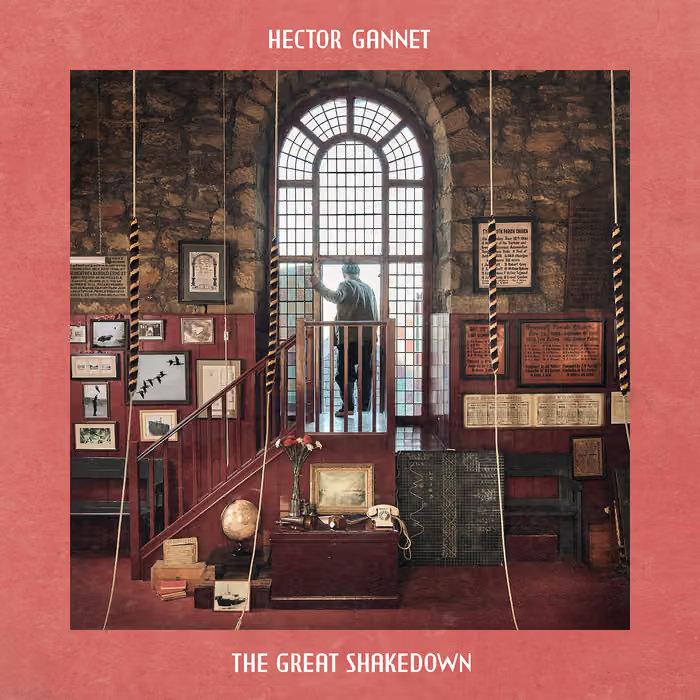
BIGGER & BROADER, SOULFUL & DOLEFUL
This I have been patiently expecting, it proving a long old wait since the promise ignited by their appearance at Manchester Folk Festival in 2025. With episodic singles strategically ramping up the anticipation, has it been worth that self-restraint? And what Hector Gannet will it reveal? Will it be the poignant nonchalance of the solo performer or will it be the brash brassiness of a six piece, or even eight piece band? Or something in between? For Hector Gannet, the band/brand is built around one Aaron Duff, who can be all and each of these. depending on the circumstances required. Of course, it helps that he has a shed load of reliables and recommended to swell his ranks when so needed. As we will see.
Earlier releases have seen the band filed definitively and directly under folk and rock. Here the palette is bigger and broader, bringing in inflections from wider horizons, soulful horns, doleful bells and a full choir to raise but three of the contrasting aspects on array. And if it his North Shields terroir that has prevailed within the inspiration of songs, again, that net is cast wider and more metaphorically: communities dispersed and industries silenced, warnings rung loud.
AN EMPHATIC BEGINNING
It is with the casually precise strums of an electric guitar that the album opens, with a swell of brass and Hammond swooping in to underscore Duff’s declamatory vocal. Hugely catchy, there is a whiff of somewhere between Dexy’s and, equivalently local lad, Sam Fender, about the whole. Setting out a table as strongly as this can do absolutely no harm, the wash of sound augmented by semi-shouted bvs. I can also hear a hit of Mike Scott in Duff’s delivery, were the Waterboys ever to go fuller into the full Muscle Shoals. It’s an emphatic beginning, and, lyrically, not a little cryptic, adding to the mystique. Or intrigue. Or both: “Now they’re giving you the runaround, get ready to follow me down; for so long now, I’ve been waiting for the great shakedown.”
Let It Pour maintains the deep and rich indebtedness to soul music at its horn heavy finest, as Duff simultaneously refuses to dilute any iota of his accent. In the flurry of competing influences, this song carries also aspects of Thin Lizzy, of Lynott at his louchest. There is also a neat guitar solo that sneaks right up, grabbing due attention, this coming from either Duff or fellow guitarist, Martin Wann. Seven Signs we know, the single from way back in March, and, if anything, in the context of the accompanying songs, is even stronger. The brass arrangements all come from Jason Holcomb, who plays the trombone, and did so, previously, with the O’Jays. Faye McCalman provides the saxophones, and Billy Bradshaw and Tom Rushton share trumpet duties.
SPLENDOUR OF POLISHED BRASS
The onward rush thus far strips right back for The Boat In The Bottle, for which the brass mutes, allowing Duff to accompany his vocals on acoustic guitar, the piano of Alex Blamire and discrete metronome of Jack Coe’s drums adding applicable atmospheric. Joe Coady, on bass, plays not a note too many and this flip, to the exuberance of the first three songs, shows they have more than one calling card. A 1,2,3, 4 introduces the similarly slower sway of Full Circle, Duff ‘s harmonica an additional texture within the wholesome broth.
I just can’t get over the splendour of Holcomb’s lush arrangements, whoever thinking this American musician would end up as head of brass studies at Newcastle University? For already polished songs, this applies a depth that shouts sheer class.
Readers of a certain age may struggle with T-333.942.918-0, aka Big White Telephone, remembering that that epithet used as a metaphor for late night regurgitatory “confessionals” into Thomas Crapper’s finest ceramic. That aside, it is a splendidly raffish concoction of street worn jazz, as Holcomb’s trombone steps out alongside Blamire’s keys and Duff’s now more subdued vocal. Coady’s bass walks up and down like a dream.
Unlike anything much else so far, it’s could be the secret keeper of the project. As The Mother Tongue follows with a possible Dear John to his home culture and environment: “Put the headlights on, and I drive without a destination; it’s hard to say so-long when brother, we were born, talking in the mother tongue.” Either which way, it’s a nostalgic organ and brass construction that maintains a swagger in a possibly grieving step.
DUFF IN A SNAP
Hopefully not where the protagonist of Mother Tongue was headed, The Jetty’s End starts with church bells, against a hover of background sound. Although, in a way, it may be, if many years later, the narrative possibly that of an old Coaster, as his ashes are taken to the river mouth. My conjecture, but it is an enduring image. The song mashes up various styles effectively and efficiently, and is the possibly both the most and least “folkie” song here, improving further with each repeated play. And, if you wanted an instant snap of quite what and to whom Duff stands for, this might be the one. More great guitar, too, before seagulls begin to bring it to a close, with funereal church organ, ahead a final triumphant fanfare of brass.
I guess I wasn’t expecting a maudlin piano ballad next, but that is what comes, for A Stitch In The Fold, the brass now more reminiscent of a Sally Army processional. As Duff is also adept on piano, I am guessing it is here him. This, too, seems a song of goodbye: “Now everybody’s here, we’ll take a cup of kindness for you; ’cause there’s a feeling in the air, yeah, there’s a little something In the atmosphere.” there may just be something in your eye, as well.
As an organ peals the start to No Money, No Time (The Great Reprise) you might feel the album destined to end on this emergent downturn of mood, but it is a false (deliberate?) alarm, as the horns breeze in with one of the earlier heard riffs, in a happy go lucky, pick yourself back up, keep on keeping on accolade. Is it sad? Is it celebratory? Does it matter? The backing na-na na-na-nas become ever more choral, and it is whatever you want it to be.
A BELTER
This is a belter of an album and nothing quite as expected. Two years ago there was no brass and precious little much else than Duff, singing near unaccompanied, as the rest of the band sat patiently about him. It was good, sure, but this is great!
Here’s the title track, which opens the album:
Hector Gannet: Website
At The Barrier: Facebook / X /Instagram
Categories: Uncategorised
