
Craven get an A for this distinguished assault on the classics, mixing polish and purpose with a raw vocal appeal.
IDLE, DISGRACED OR DEAD?
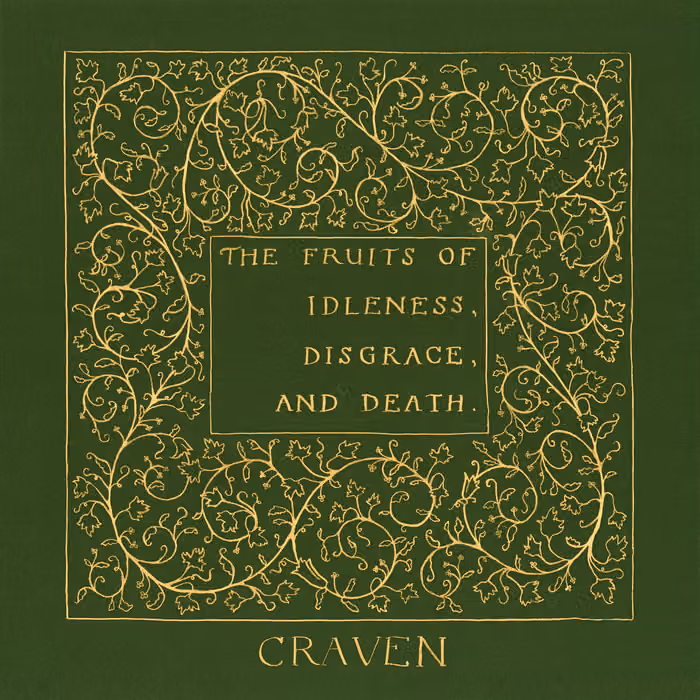
I’m not going to lie, a good part the draw of this album was, and still is, the title. All the more given some unfamiliarity with the artists concerned, Craven, an Anglo-Welsh trio from Bristol. This is their longform debut. They like to describe their output as cinematic folk, and, whilst, yes, I can see their point, the cinema in question arguably closed in 1963, the building remaining a deserted high street reminder of better days. This isn’t a put down, but their folk is more, to me, of a deeply traditional folk noir, if full of today’s de rigeur drones. All three sing, after a fashion, blending their gloriously unreconstructed voices against a background of, amongst others, squeezebox, fiddle, viola da gamba, harmonium and double bass. And a 200 year old stomp drum.
POST APOCALYPTIC FOLKTRONICA (ACOUSTIC)
I gather part their aim was to try and mimic the sound of old analogue synthesisers, despite plying a catalogue largely derived from the canon of trad. arr. So by using the instruments in use, first time around, you say, and yes, you’d be right, sort of, raised eyebrow and all. But maybe try to think of this as post apocalyptic folktronica, sans electricity. It’s certainly ambitious and there is certainly a grand D.I.Y. punkiness about the performances that can’t fail to endear.
RUMBLING OVER NOISY COBBLES
Opening with Billy, Don’t Cry For Me, an 1883 broadsheet that has me inescapably thinking of Billy, Don’t Be A Hero, it is not inconceivable there is a link, if unlikely. With the same tune as written by Nic Jones, to accompany the words, Craven render it an eerie, misty meander through village twittens, reminiscent of a cart rumbling noisily over the cobbles. Will Bremner sings and plays melodeon, also banging that aged drum, with Elian Moisey on viola de gamba and Rhiannon Takel on mandola. Bremner’s voice is thin yet characterful, contrasting well with the additional coos of his bandmates, ahead a choral close.
Their individual take on Willie O’Winsbury we know, an earlier single. Moisey’s fiddle is tremendous and pairs well with bowed double bass from Takel, the other than expected melody growing on me by the minute. Onward, and Crow On The Cradle sees Takel take the vocal helm. Melodeon and viola de gamba make another gracious and statuesque sound, fiddle adding an extra layer of class, the whole like those ragged string sections on the Hutchings/Kirkpatrick The Compleat Dancing Master. Takel sings sweetly and without overthought technique, which, as the background gets all the gothic, is ideal.
SOME SPLENDID SONORITY
Most of these songs are well travelled, but never much do they invite much comparison with better known versions. This is well demonstrated by The White Cockade, which gives off some clever fumes of originality, almost as if their’s the first version, and caught on cylinder at that. The slow and brooding Elephant, is an instrumental and seems to be a funereal take on the Martin & Eliza Carthy tune, The Moral Of The Elephant, itself based on various historical sources. It is gorgeous piece, the bass booming out some splendid sonority. Is it a favourite? It could be.
Welsh becomes the lingua franca for Yn Harbwr San Francisco, a song well known in the principality, and sung charmingly, Takel again. Amidst all the impenetrable consonants, the name of the harbour, each time it gets a mention, is strangely affecting, so out of context it does seem. What sounds like harp is likely pizzicato viola da gamba. Butter And Cheese And All is probably a little too jolly for me, my preference always dirge over dithyramb , even if it one of the instrumental highlights. The trio sound like an entire medieval ensemble.
It is then back to the Nic Jones repertoire for a sober Humpback Whale. It feels somewhat reconstructed too, with an extra verse, which explains Takel’s name on the credits. With Nic Jones in revival, courtesy Sam Carter, it is a timely iteration. I’m liking this album a good deal for the novel approaches offered, across the board, to these all too often carved in stone standards.
CHAMBER GLOOM MURK
I love a good old song about poaching, me, and Rufford Park Poachers is one of the best. Oddly, and somewhat against the grain elsewhere, this is the least adventurous of the songs revisited on this album, bar some vigorous chops across the varied strings. Amongst all these stalwarts of the tradition, you could be forgiven for mistaking The Old Main Drag for another. Indeed, I had to look and check, the arrangement fooling me, but, yes, it is the Pogues’ song, as penned by Shane MacGowan. And never has it sounded quite so ancient, with wheezy melodeon, harmonium and percussive strings. High Germany then appears as a slow burner, with a musical quasi-overture preceding the vocals. This one really milks the chamber gloom murk the band mine so well.
Worker’s Song gets a passioned performance, the narrative rhetoric of Ed Pickford’s words contrasting with the bittersweet string arrangement, as if to underline the near inevitability of workforce oppression. The gaunt fragility of the strings are the last instruments heard, as the set closes with an acapella Adieu Sweet Nancy. By now these voices have fully bedded in and it is a gorgeous old sing.
A DELIGHT
Produced by Alex Garden, this album is near all delight, and is well up to the standards that one would expect of that name. (The Tarren/Sheelanagig/Drystones multi-instrumentalist also performs in a trio, Bearpit Ceilidh, with Bremner and Takel.)
Try out a live version of Billy Don’t Be A Hero, sorry, Billy Don’t Cry For Me:
Craven: Website
At The Barrier: Facebook / X / Instagram
Categories: Uncategorised
