
Go (Folk) East, young man, they said, (it’ll be quicker than going west). A superlative Suffolk shindig well worth the celebrating.

A JAUNT
They didn’t, and it is, I guess, true, but it still seemed a heck of a jaunt into the wilderness of Suffolk’s agricultural hinterlands to get there, with a very grumpy Og arriving after dark. My bad, I set off too late, thinking that once I was at Cambridge I was nearly there. Ha! But, such the delights on offer, almost immediately my mood lifted into elation. At least once I got the hang of putting up my tent in the dark. Let’s rewind……

THURSDAY
A MAJESTIC SPRAWL
Folk East is held on the Sotterley Estate near, in the loose sense, Beccles, it’s second year here since resiting from Glemham Hall, nearer to Ipswich. It is a massive area, farmland, as well being a SSSI, a site of special scientific interest, for the richest array of epiphytic lichens in East Anglia, doncha know, which adorn the ancient treescape. The festival sprawls over a number of fields, with a main stage occupying a grand site, looking down from the majestic Sottterley Hall as a backdrop, to the stage, in the dip of the valley, in front a large ornamental lake.
There are two other main music venues as well as myriad areas where all manner else can and does pop up and takes place, sometimes as if by chance. A lot, and I mean a lot, of effort has gone into thinking out the geography and making sure there is entertainment sufficient to satisfy the toddler to totterer age range of punters represented, and all in between.
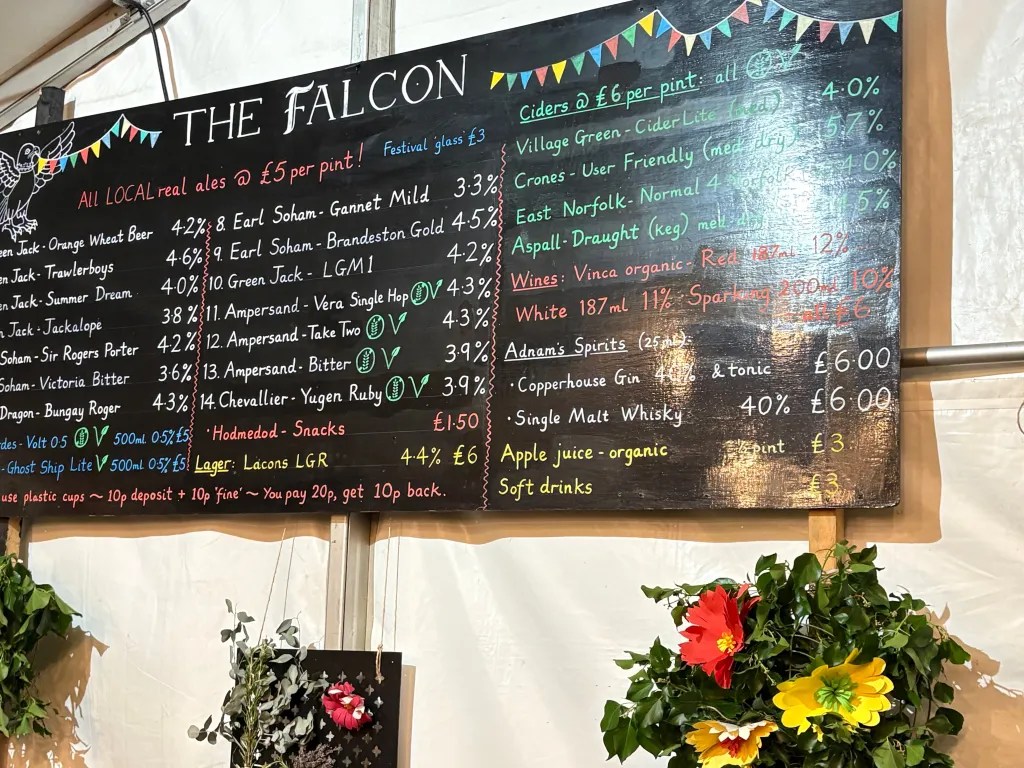
No real time to explore, that needing daylight, I made sure of the essentials I would need for this lower key soft opening night, and they were the bar, the dance tent and the Moot Hall. The East Anglians take their beer seriously, and Folk East is one of those folk festivals that aims for the bar experience to be a bit of a beer festival as well, with an array of local brewers supplying the ales. So a pint of their Festival ale, Jackalope, named after the festival mascot, and I was ready. A jackalope is the fabled stag bunny, an extravagantly horned jack rabbit, and, whilst I didn’t spy any in the wild, there was a woven branch effigy of one in the festival marketplace, akin to the fiddling fox at Cambridge.
PURE DURACELL
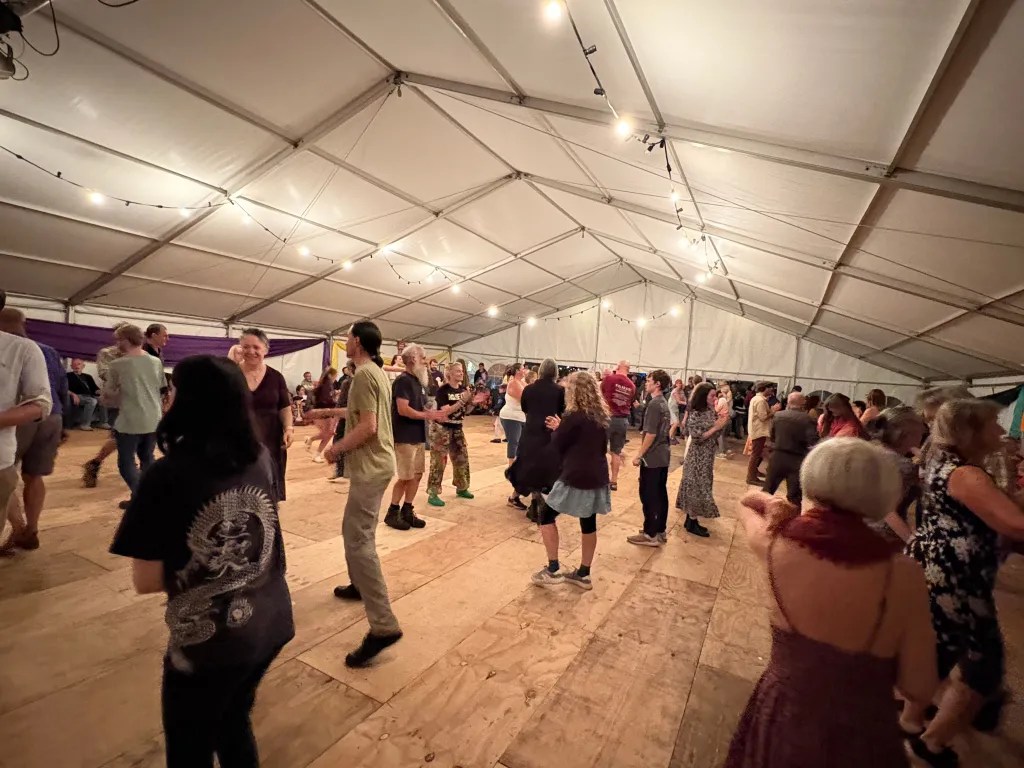
To entice early arrivals, Banter were opening the dance tent with a ceilidh, it in full swing as I arrived, hearing the warm glow of brass and box as I came close. With a new album, Hard Times, hot off the presses, review incoming, this was more dance than concert, but snippets of the songs and tunes were recognisable. Whilst my knees said no, my ears said yes, and it was a joy to listen to and see the wallop of enthusiasm that the four members of the band, and their caller, put in.
Simon Care is pure Duracell as he squeezes away manically, but Tim Walker, on drums, is near as entertaining, especially when he multi-tasks on trumpet. Mark Jolley is increasingly becoming the meat between their two sandwich slices, adding either bass or fiddle to keep the whole jalopy road fast. With maybe less to do at for a dance, singer and pianist, Nina Zella was determined to be more than mere garnish, mind, with fiercely percussive keyboard runs. The floor was packed.


HAIL THE DADDY!
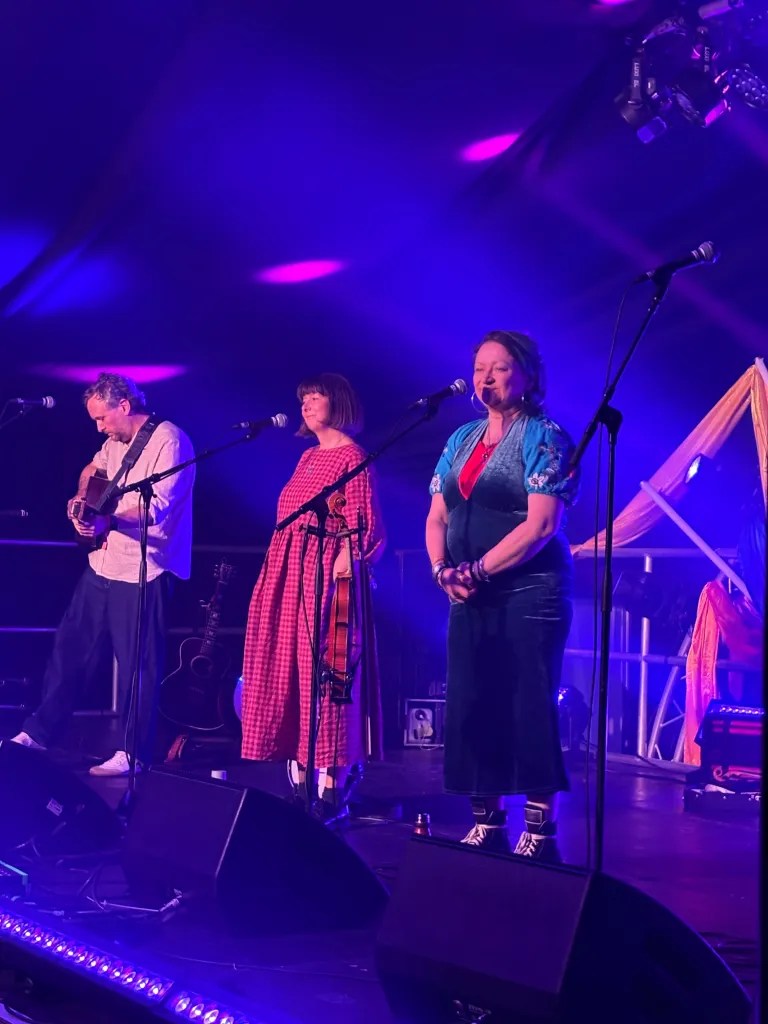
Needing to slip away to the Moot Hall, this is the main undercover setting for music, a marquee of some considerable size, with seating, with room for further spectators at the sides and at the front. A late addition to the bill had been a reprise and repeat performance of the recent Songs of Martin Carthy show, that had toured in place of the great man, given the cruel development of his dementia. Like these shows, this was curated by Jon Wilks, current minder of the Carthy guitar. He and Eliza Carthy described and documented the life of “the Daddy”, in both song and anecdote. Sharing the vocal duties were Angeline Morrison and Emily Portman, with extra instrumental support from Martins’s grandson, Eliza’s son, Finn Curran-Carthy, who had learnt how to play his grandad’s guitar in the same distinctively idiosyncratic style.
The stories came thick and fast, as his spirit was invoked, with equal parts affection and humour. His best known songs featured, including High Germany, and The Trees They Do Grow, ending, naturally, with Scarboro’ Fair. It was a lovely tribute, which saw Carthy’s daughter stumble with her words, such the emotion, as she described the rationale behind Transform Me Then Into A Fish, being used as the title of his last released new album, a line from the song, Ye Mariners All. It is Carthy’s own figurative wish for himself, when the end comes. Lovely stuff.
With nothing to top that, it was time for an early retreat to the old sleeping bag, after a quick check in back with Banter, still firing away on all cylinders.
FRIDAY
MORE THAN MUSIC
Friday meant I could get a gander around the site, and actually see what’s what. This involved a surprisingly modest step count, with pride in place being the extensive craft village, with stalls both within a marquee and spilling around a further square, encompassing woodcarving, weaving, pottering in all manner of materials and a variety of arts deemed invalid to a 21st century. Opportunities were also laid on to have a go. A row of instrument makers were also present to show off and sell fiddles, bagpipes and bouzoukis. I can’t play, but it was grand to see their handiwork and to lap up the enthusiasms expressed.
Elsewhere I met Elsie the Dragon, a terrific robotic creature, blowing flames as she vogued any number of shapes, one option allowing spectator control of her movement. A resolution was made to return by dark. Workshops aplenty were luring in any nascent performer, to sing, strum, bow or blow, with an extensive yoga class filling and spilling out the Dance tent.
SOUND ROOTS
My day of music was timed to catch some acts in the Barn, the final main stage, a magnificently restored Tudor barn, all massive exposed wooden beams, vaulted ceilings and brick walls. A stunning building, this was to host various connected and curated showcases over the days of the festival. Today it was the turn of Sound Roots, that branch of the Arts Council of England that specialises in facilitating folk, roots and acoustic progression, with sets from newer and upcoming headliners of tomorrow.



PODORHYTHMIE & CEILIDH WITH A T
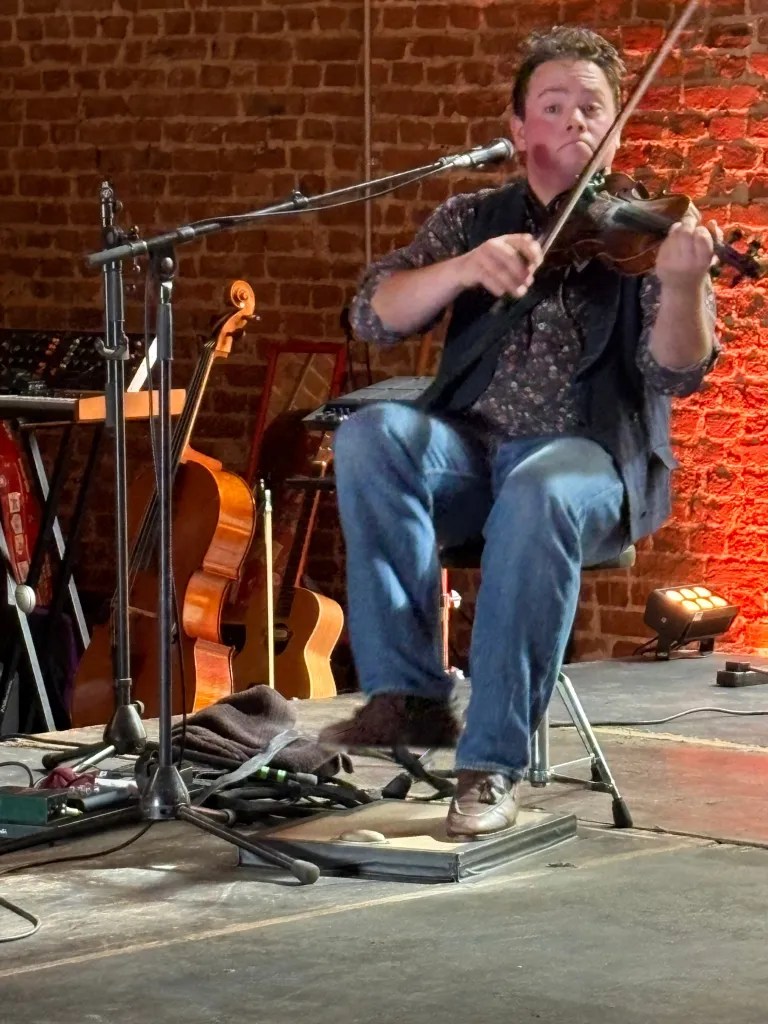
First up were a duo last caught at Celtic Connections a couple of years back, Arthur Coates and Kerran Cotterell. Specialising in old tunes and songs from the various UK traditions, that found their way to the Canadian Eastern seaboard, they gave a vigorous wake up call to anyone yet to fully carp the diem. Fiddle, guitar, and voices yomped through 50 minutes of high octane Nova Scotian fireworks.
Coates, on fiddle, is also an advocate of podorythmie, the percussive foot dancing, that accompanies the playing his instrument, and that is such a feature of that part of the world. Between blistering instrumentals, Cotterell was able to show what a fine singer and guitarist he has become, as he has stretched out from the understandable shadow of his partners exuberant showman fiddler persona, the two now equals. A highlight was an acapella version of Joni Mitchell’s Fiddle And The Drum. A top class start to the day.
Up next was Ceitidh Mac, who brought with her a band of buddies from her Newcastle home. including the redoubtable Francesca Knowles on drums, more often found alongside Amy Thatcher, or, more recently, with Thatcher too, providing the live folktronica wallop for Frankie Archer. Mac is a jolly soul who sings her own songs, playing, variously, guitar and cello, playing a few songs solo and then some with the band, which included also keyboards and guitar. Fumes of a jazz phrasing filter into both the vocal and instrumental delivery she offers, with the ambience, especially then, as the band added their own tones and textures, landing most closely into a freak folk sensibility, ideal for the warm sunny early afternoon.
VOICES COINCIDING PERFECTLY, WITH SOMETHING TO HEARK AT
Time then to wander into the natural arena of the Sunset Stage, for the first act there of the day. This was SykesMartin, the duo of Hannah Martin, from Edgelarks and the Gigspanner Big Band, and Miranda Sykes, who no longer needs her c.v. reminding. This was a tremendous hour, their two voices coinciding perfectly, in delicious harmonising. Taking turns to take the lead, each showed quite why they are held quite so high in regard. With a splendid array of available props; tenor guitar, fiddle, banjo and Sykes’ big old bass, all were given good use, over a selections of songs drawn largely from the tradition. Martin’s usual partner, Philip Henry, looked on anxiously as she played his prized resonator guitar, but it was in safe hands. Utterly splendid, with the promise of some new material in the offing, to sit alongside their now sold-out first disc.
With the day now fully up and running, the curse of clash finder was taking effect. Having said, Folk East try very hard to allow punters opportunity to catch most, at least, of the Sunset stage and Moot Hall acts, timings carefully staggered to allow a canter between the two. But, caught between those stools, I wanted also to catch the Hearken Quartet, whose Eurobal dance music had proven so pleasing on my ear, at the top of this year. Playing the dance tent, I had only time to capture a couple of tunes, but it was clear that release was no fluke, the playing exemplary, uillean pipes fitting so well into their wall of sound.
GURNEY & McGOLDRICK
Who dragged me away? Well, never having caught live the wonder of Tim Edey, this I was determined to do. Today he was in a duo, with old buddy, Mike McGoldrick, a fabulous pairing. Edey is an astounding self-taught guitarist, with a strikingly percussive technique and an ability to find notes that none else has ever been brave enough to seek out. He also does tremendous gurn, pulling all manner of entertaining faces and poses as he batters his guitar into submission, together with free-fall associated commentary between, and sometimes during his play. McGoldrick, clearly, can do no wrong, one of the few musicians who can keep up with Edey. McGoldrick sticking mainly to flute and various whistles, the two provided a tremendously melodic racket.
Midway it seemed the percussion had added and extended, it turning out the elements were now joining in, as what sounded torrential rain hammered on the roof, as the audience expanded drastically, with an onslaught of bedraggled and soaking folkies. As Edey switched to melodeon, McGoldrick told the story of how he first encountered the prodigious talent sat beside him, hearing the energetic play of the then 13 year old, playing guitar in a pub garden. On that cue, Edey gave McGoldrick his guitar, showing that, who knew, McGoldrick too is no slouch on strings, whilst the range of the melodeon stretched away exponentially, in Edey’s grasp. Wonderful musicianship and wonderful showmanship, ending on the haunting O’Carolan air, Tabhair Dom Do Lamh.
JIG ON
Over on the Sunset, Jiggy were up next. A band with a recorded history I enjoy, being, loosely, an Indo-Celt Sound System, often sharing members with the Afro-Celts. Live, however, I have always struggled a bit. Stripped down to a front line of uillean pipes, fiddle, squeezebox, Indian percussion, and vocals, with guitar and drums for ballast, most of the attention was taken by the irrepressible Robbie Harris, on additional percussion, programming and bodhran, the latter usually from the front of the stage, along with audience exhortations.
Musically they were exemplary, as were the vocals of Eoghan Ó Ceannabháin, but, for me, there was too little attention to the role of Koushik Chandrashekar, whose percussion was mixed too low. There could also have been more of his distinctive konnakol, the rhythmic scatter shot of vocalese familiar from the Indian tradition. A curiously sterile set to my ear, nonetheless the arena audience went crazy, so what do I know!

A RADICAL BRUMMY BONFIRE
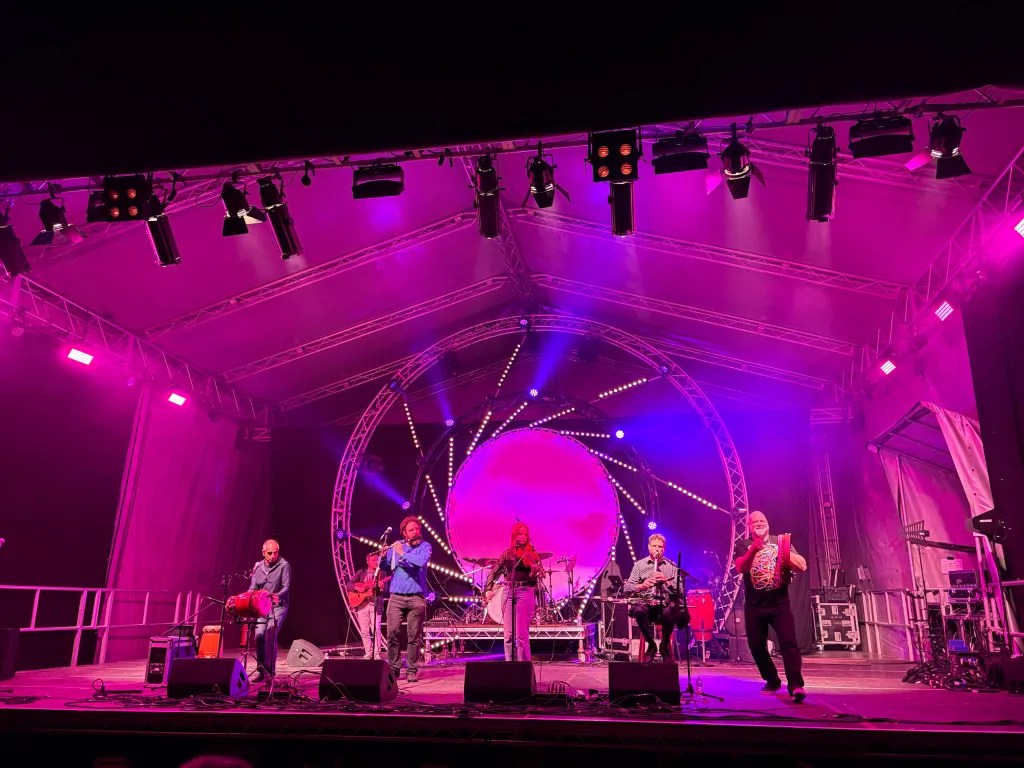
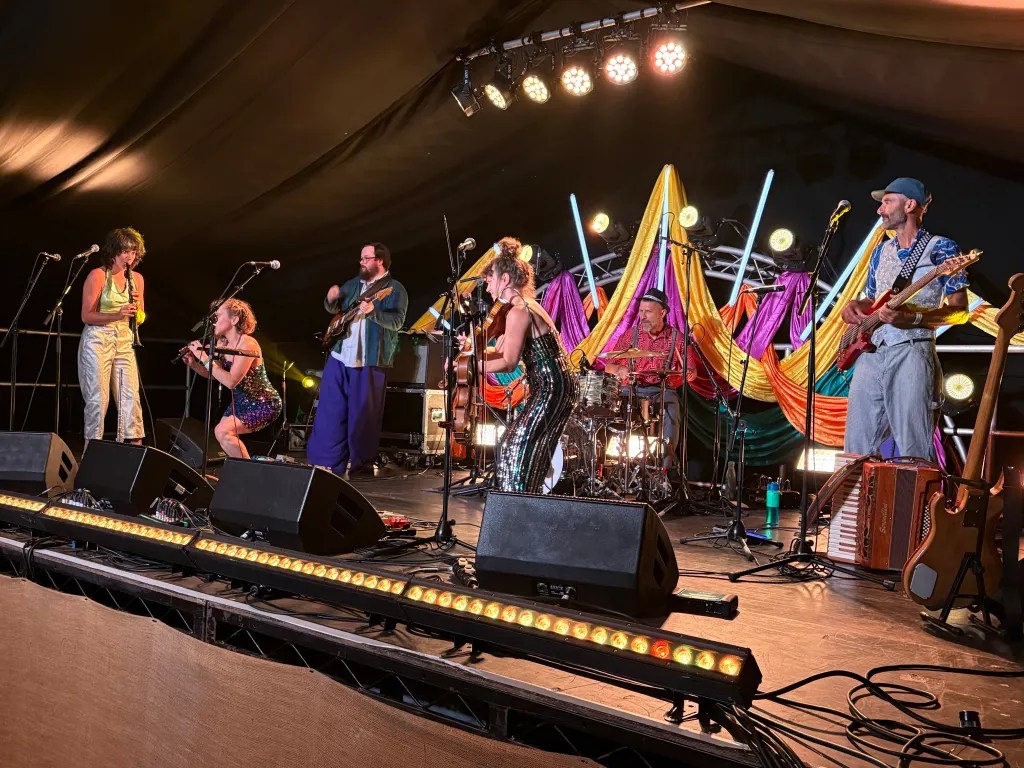
Not knowing quite what to expect, last up for Friday were Birmingham’s Bonfire Radicals, a band staunchly commended by many I know, and whom I have been wanting to see for a long time. Deliberately resisting the temptation to pump prime their sound on Spotty, I went with completely open ears, astonished by what I heard. For, if this was folk-rock, it was like no other, fitting more into a hitherto unappreciated genre of electric prog vocal folk dance.
Veering largely to traditions neither celt or anglo, this was music with a home at the wider fringes of Europe, a mix of Balkan and almost Middle Eastern styles, with Nordic, Greek and Gypsy influences all seeping in aplenty. Shetland, too. This was characterised by the array of instruments plied by the six piece ensemble, with clarinet, fiddle, recorders, accordion, guitar, bass and drums, with often choral ensemble vocals.
Against this diasporic panoply came curiously English song titles and lyrics, referring, variously, to Suburbia and Spaghetti Junction, with old style humour ladled often in; think the Goons matched with some of the more eccentric Canterbury prog band whimsy as well. On paper an unholy alchemical mess, live it was a joy, as exhausting to watch as to listen to, as the front line of the band lurched and careered all over the stage in rapture. Special mention for the pocket volcano of Michelle Holloway on recorders, flute and vocals. Seemingly inventing genres on the hoof, if not by name, surf klezmer and mittel Europ ska are two of the phrases that leapt out, unannounced by anything other than the bizarrely beguiling concoctions cooked up on stage. Deffo the new discovery of the festival. What a show!
SATURDAY
FODDER STOPS THE SIGNAL
More exploring on Saturday morning, following the now obligatory flat white and cake that kickstarts days at Sotterley, via the superb Caffe Mobile, conveniently placed by the entry from the campsite, at least from my part of it. Which is as good a time and place as any to commend the range and selection of food stalls. Festival food is always a treat, tending as much to the naughty as the nice. Any and every taste catered for, I tend to espouse my carnivorous tendencies and go vegan(ish), pretending to myself it a healthier option. Not with these portions they ain’t, with special shouts for Vegetaria, and The Curry Cart, although a a fantastic lobster roll from Shoebox insists also on mention.
The main bar, the Falcon, I have touched on, but there were others dotted about, all of which shared the same range, with others specialising more on gin, rum and whatever. As is the norm, both impromptu and arranged sessions would materialise in these watering holes, causing a tendency to linger longer than thirst might strictly dictate. There was also the wonderfully tiny Halfway Inn, a bespoke shed with a bar and a barrel, and little room for else.
So why about the signal, Seuras, this often a concern for the technically minded, especially if, ha, supposedly working. Virtually non-existent is the answer, a small stall the base for the solitary hot-spot, around which all with phones were nervously hovering. Actually, what was initially annoying became quite invigorating, the sense of freedom from the outside world extended thereby.



BONKERS & BASHFUL
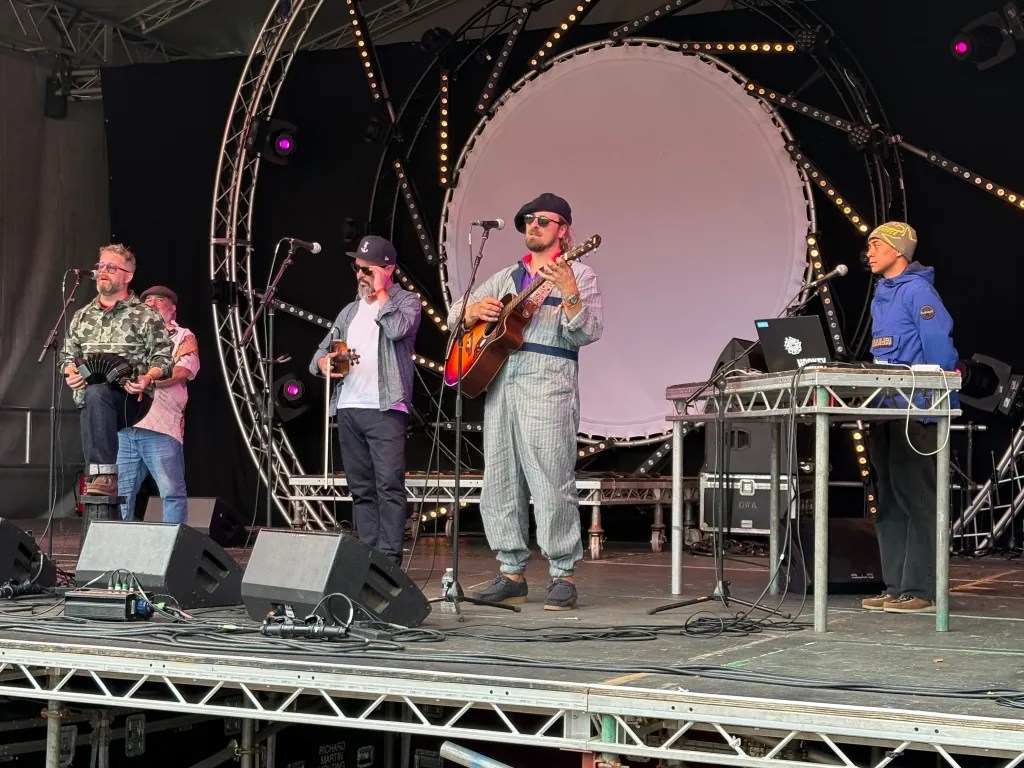
To music, and the Barn was today hosted by, again, Jon Wilks, for a further series of performances to reimagine the vibe of Soho 6o’s hotbed of the then edition of the folk revival, Les Cousins. This he had seemingly launched last year, it proving a success worth reprising. It was thus that I got the break of witnessing the eccentricity of Spitzer Space Telescope in the flesh.
Not the now now decommissioned infra red portal to the skies, this is the nom de tune of Dan MacDonald, who we reviewed last year as being like the “Clancy Brothers on psychedelic scrumpy“. Totally bonkers, on stage he comes across like the secret locked-away brother of Bonnie ‘Prince’ Billy, with a set of old-timey Appalachian style songs and shanties. With a cajun yelp of a holler, he sings either acapella or self accompanying on guitar or fiddle. And none of yer neatly tucked under the neck file either, held proudly horizontal to the sternum. A progressively manic masterclass in moonshine and self-belief.
Unable to stay for the whole set, Gwenifer Raymond followed him. This young woman has a perplexingly complex style as she hammers the six bells out of her acoustic six strings. They call this type of style American primitive and it is certainly anything but the latter, such the florid flurry of notes at her command. What, on record, might sound a little academic and staid, it is transformed live, as you witness her blistering right hand at work, as the other flies all over the frets. She says very little; she doesn’t need to.
HIP HOP SHANTYMEN
A chance encounter with a scribe from another platform, hi, Jeremy, led me to the next act. I am not, usually, a fan of the current vogue for sea shantying troupes, with their yee-haws and hand actions, but I was told not to miss Pressgang Mutiny at my peril. Not wrong, this Toronto quartet were superb. I say quartet, but, in fact, the four singers had recently recruited a young fella on decks and beats.
This transformed the overall sound and ambience, as the ancient ditties were graced with hip-hop and EDM/D’n’B rhythms that made for the fully transformative. OK, the main band were terrific singers, adding also guitar, whistle, concertina and more, but, with their new recruit, this was a revelation. Belying their city of origin, some songs were sung in French, for good measure, they also getting the afternoon audience into song with the closing Rio Grande, if confusingly sung Ryo. Another cracking find!
Unable to capture The Young Un’s set the night before, there was a sort of ability to make good, as the trio were recording a podcast in the Moot Hall. Understandably, given the stewardship of David Eagle and his wicked quick fire wit, this was a hoot, being a semi-shambolic chatshow with settees on stage, featuring guest spots (and songs) from guests like Emily Portman, Sam Carter and the just offstage Pressgang Mutiny. Not much from the boys themselves, but a fabulous idea and a great way to pass an hour.



SUNSET HONEY
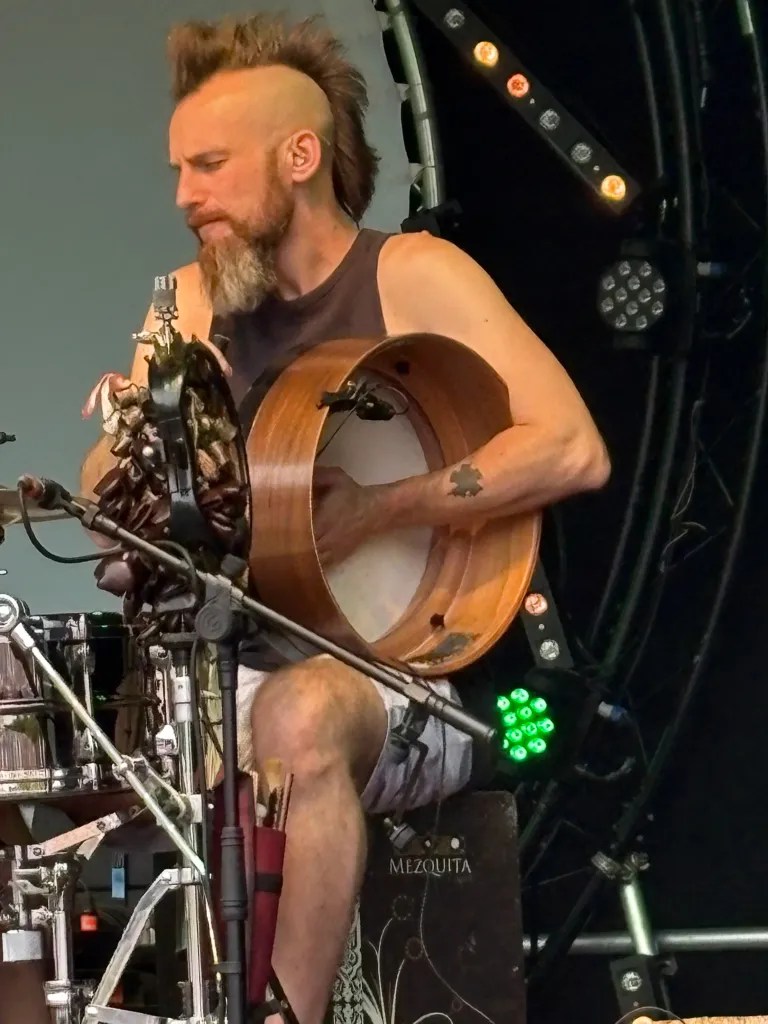
Back outside and no sign of the rain of yesterday, the thermometer was rising as Honey & the Bear were taking the Sunset stage. Having before seen the husband and wife pairing of Lucy and Jon Hart, I am becoming fond of their warm elegant and ornamental songs of East Anglia. Often joined by various Lost Boys, today we had the full set, so Toby Shaer, Archie Churchill-Moss, Graham Coe and, last but not least, Evan Carson, were present, so the sound was rich and varied, with flute, fiddle, melodeon and cello to complement the guitars, ukes, banjo and bouzouki of the Harts. Not forgetting the big old double bass they share.
A set that made quite a whack into their recent album, it was perfect summery fare, with the relish of also being able to witness, up close, stage left, the remarkable hybrid kit of Carson, that he plays so inventively. As Shaer shifts from fiddle to whistle, it is as if the level of play, and the energy therewith, jumps a notch and I can think of few better ways to spend a Saturday teatime. Add in the new version of Sandy Denny’s signature song, Who Knows Where The Time Goes, with which they closed and that Lucy Hart sings so well, shifting the dynamic a little away from the expected, and they have certainly made a lot of new friends here this day.
The HIT…
Having seen R.T. so recently, at Gate To Southwell Festival. I was planning on taking a swerve, then unable to, as the hour approached. R.T., of course, Richard Thompson, along with the current Mrs. T., Zara Phillips. If I was worried it was going to be a duplicate show, I was swiftly proven wrong, as, to begin with, a solo Thompson commenced with If I Could Live My Life Again, a song I have never heard live before.
Thereafter, if many of the same songs as before were reprised, they were in a different order and, more importantly, with different introductions and varied banter. More jovial tonight, we got Genesis Hall, Turning Of The Tide, Beeswing and Down Where The Drunkards Roll. The newer Johnny’s Far Away is growing on me as a regular in the set, which he followed with Walking The Long Miles Home and the never knowingly too often 1952 Vincent Black Lightning.
…AND THE SINGLE
Enter Zara, possibly a little later this time around, and it was the new single, Cocaine Walking, Booze Talking. Now more familiar with the song, and mindful of the recorded full band version that makes up the single, the stripped back version makes more sense and sits more easily on the ear. A couple more oldies but goldies and it was time again for the same brace of preview songs from the forthcoming album, due in October. Locking in better on second exposure, the Everly’s like Pipedreams is an emerging high spot.
Having mentioned the current single, of late it is always the single, aka the hit, with which Thompson finishes, with a marvellous rendition of I Want To See The Bright Light Tonight. An added extra was that an encore was actually squeezed out the great man, festival slots often negating that option. Coming in the form of the delightful deep cut, Tinker’s Rhapsody, from one of the two lock-down EP’s he jibed no-one ever listened to at the time. I did, it lovely then and was lovely again tonight.
A SOLID WAEVE
Turning into a busy old day, I had made an executive decision to forego Elephant Sessions, a bold move given they are amongst my favourites, but, like R.T., they had too been on at Southwell. I thought I ought spread my palate a tad wider, and so returned to the Les Cousins sessions at the Barn. This was to check out what all the fuss about Graham Coxon’s The Waeve was about. It was rammed solid, which augured well. We have a saying at ATB about reviews: if you can’t say anything nice, say nothing at all.


“….AND I FEEL FINE”
So next up was the keenly awaited Jim Ghedi, his recent album a stonker from the abyss of apocalyptic folk-rock. Uncertain whether he was to be with band or alone, the truth was neither, he just having fiddle player, Owen Spafford, with him. Utilising a synth/computer for drone effects and more, Ghedi shifted between acoustic and electric guitars, each as end of days as the other, over which Spafford wove post-folk reams of melody. Ghedi famously found his falsetto during the making of the album , utilising that eldritch wail frequently and freely.
A, let’s say, odd, sound, it was nonetheless perfect for this dark material. His voice, elsewhere, was more a Thompsonesque growl. Not necessarily easy listening, the set was astounding to witness, and fully engaged the attentive audience, even to the apparent surprise of the surprisingly quiet and self-effacing singer, in his between song patter. It was as if he couldn’t really believe people were liking this. Many of the instrumentals and some of the songs came straight from the tradition, or from celebrated musicians schooled therein, but not anything quite as the tradition might normally expect. It was magnificent.
Flagging, a quick glance in the Dance tent revealed a ceilidh of collisions, as Notorious J.I.G. applied their polka hip-hop fusions, which was all a bit lively for me. Likewise, with my mood for bombast tempered by Ghedi’s glorious holocaust, the pomp-prog of The Trouble Notes, however good, and it was, was beyond me. The whirling dervish that is Bennet Cerven, and his undeniable mastery of the electric violin was clearly technically superb, as was the precision clatter and the sturm and drang of his drummer and guitarist, but it was all too clean cut for my sullied conscience, which was calling for my tent.
SUNDAY
GOD OR MORRIS?
Day four coming all too soon, the fact it was a Lord’s day became apparent as the bells of the Sotterley Estate Church rang out, for those so enthused. A lovely sound and a beautiful building, my interest was taken by the rather more plain appeal of the many morris sides, congregating to perform. Cotwold, border, molly, all were catered for, the clack of sticks, and their much smaller bells, of greater interest to me.




ASLEEP IN THE BAR THEN UNDER THE FLOORBOARDS
It seeming both reasonable and sensible to greet midday in licensed premises, I came across rather a good quartet, as they busked the bar. This was Something Sleeps, whom I had missed in the Sound Roots sessions. Self identifying as ‘dream-folk’, I found that a poor indicator, content to consider them simply folk music, and very good folk at that. Two female singers, each with access to guitar, ukulele, shruti box, whistle, flute and clarinet, they had also backing from fiddle and cello. An unexpected bonus, they brightened the day with their slightly gauche enthusiasm and passion. Plus, lovely to see and hear more clarinet, seeming to be this year’s trumpet, in terms of appearances across the folk milieu.
Of all things, there was a Gardener’s Question Time ongoing in the Moot Hall as I arrived, early, for From The Floorboards. This was to be a nominally solo set from Georgia Shackleton, associated with the same-named album, celebrating her distant relative, Sir Ernest. Once the botanists and horticulturists had tucked away their peonies, Ms Shackleton arrived and prepared herself ready, sound checking for she and invited musical guests.
The back story is that Shackleton acquired a fiddle that was, in part, constructed from the Edinburgh floorboards of her famous explorer forbear. This led her into looking into all his endeavours, discovering that he and his ship-mates were all songsmiths and musicians, spending some of their time, at the Pole, writing and singing. These songs and others inspired thereby made for a delightful show. Shackleton sings well and played that fiddle with love, with her Shackleton Trio colleagues joining her on guitar, mandolins and additional vocals. Similarly, celebrated banjo player Adam Clark, joined for one number.
SPIKY SEALIFE
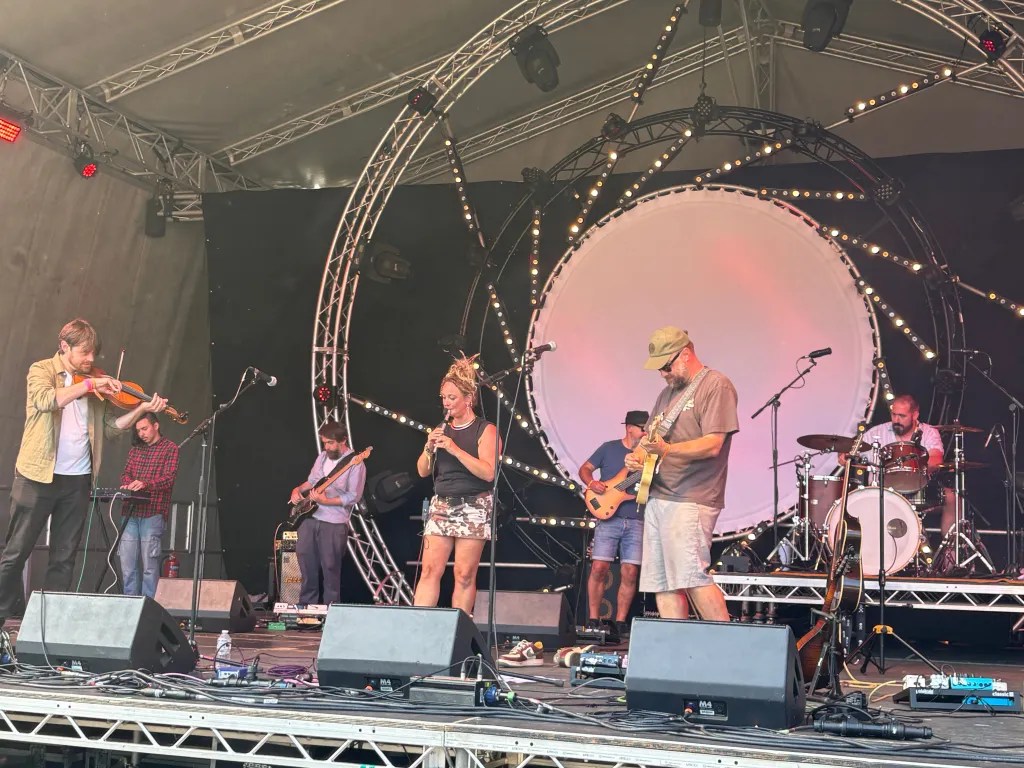
More blue skies and warm yellow sun outside at the Sunset, for Fishclaw. I hadn’t realised they still an ongoing arrangement, it now being some years since the fairly fluid band made a short run of experimentally leaning folk records. It is fair to say that they are now a little less experimental, but still have laptop and FX availability to add sonic texture. Otherwise, they are a (reasonably) orthodox band of fiddle, whistle, guitar bass and drums. No vocals, their tunes sit easy on the ear, even as the ambient textures get woven in, that aspect allowing the overall assemblage to steer carefully between noise and euphony.
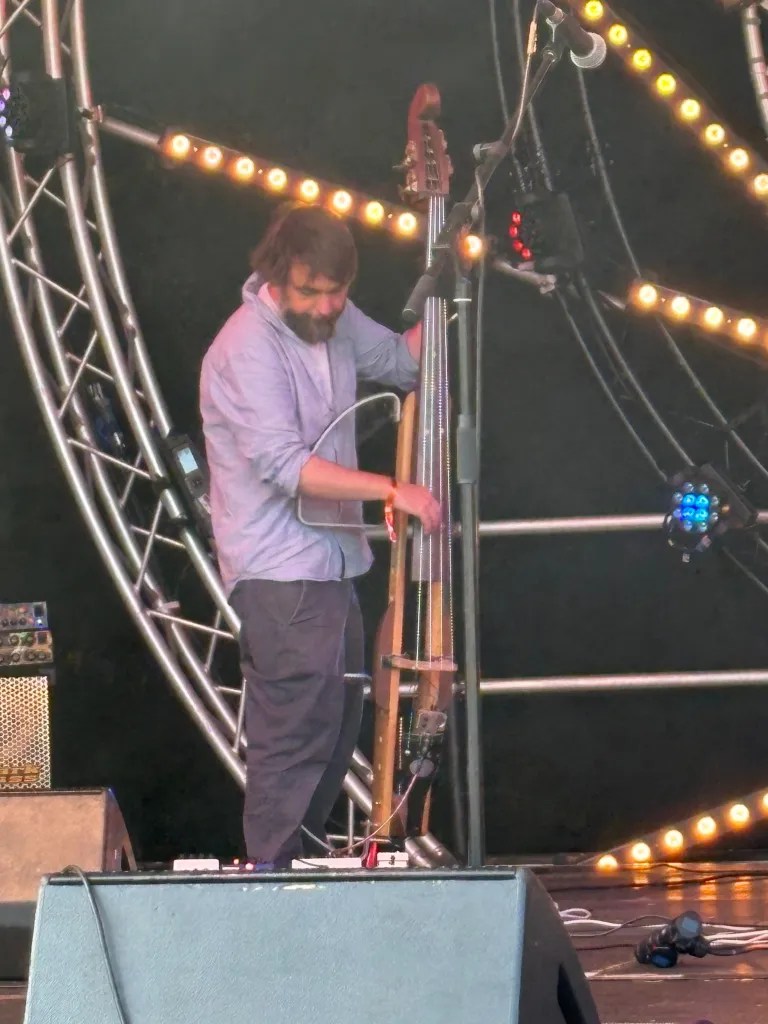
The on/off stage fella with the laptop reappears at one stage, stopping on an electric bass, making two such instruments playing at the same time, then coming back a third time with a Heath Robinson affair stand up electric bass. This visual intrigue was near as enticing the music, and it was a good choice by the festival organisation to book them. talking to the band after, they assure that some new is in the pipeline, if uncertain when.
PENGUIN EGGING
Sam Carter‘s live album of Nic Jones songs, from Celtic Connections, is proving a popular listen this year, and, making his second appearance of the weekend, here he was to play that Nic Jones set. (In fact, this was his third appearance, as, unbeknownst, there had been an unbilled Friday night Sean Cooney (Young ‘Uns) performance, about his Peter’s Field musical chronicle, in which Carter had also appeared, here and elsewhere, which was annoying to discover too late).
What can one say about Carter, other the his singing and guitar play is peerless, and, whilst he in no way sounds anything much like the Penguin Eggs album maker, he presents the material in a superlative light and draws back due, overdue attention as to quite what a fine artist was Jones. At the start he asked if anyone had not heard of Jones. A few hands. Then, asking if anyone had actually seen Jones play, a welter of hands went up. “Shit, tough gig…..” Worry not, Sam, you nailed it!


BAROQUE & REEL
Sticking in the same hall, the same seat even, it was the redoubtable Peter Knight/John Spiers combination. Familiar with each in myriad other settings, let alone Knight’s Gigspanner Big Band, in which Squeezy plays a big part, I had never seen just the two of them. And, blimey, what a show.
There are a lot of fiddle players of consequence around at the moment. Indeed a lot of fine players were represented this weekend, but there’s nobody quite like Knight. He can find notes and nuances others would say were impossible, especially at the higher and lower extremes of the instrument, as well as a having dab fingers for picking a sly stray pizzicato out a bowed note, where least expected. Squiers is nearly as good on a box, I sometimes having to check no secret sidemen tucked in the wings. Knight did admit to a gizmo foot pedal to add extra drone where necessary, but, that apart, this was all, pure amplified acousticity.
An amusing opening came as each walked to the other’s instrument, picking up as to play, ahead of knowing glances at each other and the audience. A delicate pastoral melody weaved and wafted about the roof for several minutes, ahead becoming apparent as a variation around Scarboro’ Fair. This is their MO, explained, Knight, to tinker with tunes and expectations. A Cuckoo Medley followed, to include the morris tune about, or not, the bird’s nest.
A set then of triple hornpipes became so melodramatic as to have you thinking this was what it must have been like in Venice, when Vivaldi was playing, given the sweeping baroquialisms in Knight’s dextrous play. A musical ‘argument’ between the two musicians was a diverting aside, as echoing stretched the sonic possibilities, ‘discussing’ whether it was Knight/Squiers or Squiers/Knight, before an eventual close with The Abbott’s Bromley Horn Dance. Two treasures, each at the peak of their game. Excellent.
PIPES & WHISTLES
Nearly there, it was then the turn for some Scottish and Project Smok. The trio of Ali Levack, Pablo Lafuente and Ewan Baird take whistle, guitar and bodhran to unexpected peaks, in a manner not hugely dissimilar to early Talisk, before Mohsen Amini took his muse and concertina quite so far into progland. A wonderful confection of sounds, Levack must have the hardest working embouchure in whistledom, so polished his technique from penny to low. And his speed, too. Whilst they don’t sing, the audience is invited to, adding appropriate da da da vocals to the tunes; “a bit like canntaireachd“, quipped Levack.
Many, myself included, had been peering into the gloom of the backstage area, to see if Levack had brought his ‘other’ instrument. Indeed he had, as around five or six tunes in, he strode back and picked up his pipes. Audiences love the great highland bagpipe, and the mere sight of them brought a swelling cheer form all present. This magnified as he began to play, thereafter switching between the alternatives available, often within the same tunes.
It is a shock that this bonny Scots lad should or could live anywhere but, but he revealed he is now a resident in Galway, using that moment to reveal that he and the band were equally adept at the somewhat different cadences of Ireland. I wonder whether he has a set of uillean pipes back at home and would love to hear him play them. A fine set had Toby Shaer, from yesterday’s Honey & the Bear, back to play second whistle, the two players performing a ducking and diving accompaniment, under the precise rhythmic rudder of Lafuente and Baird. Perfect.
3 FOR A GIRL
Time only allowed a brief acquaintance of The Magpies, the trio, tonight, of Ellie Goulding, whose solo set I had had to miss, Bella Gaffney, and Holly Brandon, guitar banjo and fiddle respectively, as well as resplendent vocals, both severally and jointly. Americana is the easiest handle to hold them by and they make a sweet sound, in the style notably absent from much else on offer this weekend. I would like to have heard more, but the clock was against me.


FOUND, AT THE TOP OF THE BILL
So much so that I feared I may not manage the Sunday night top of the bill, Sam Kelly And The Lost Boys. Originally it was Eddi Reader holding down that spot, but with the sudden and unexpected death of her husband, John Douglas, clearly she was unable to fulfil that, with Kelly bouncing up the order to take that honour. And if anyone felt it premature for this turn to take such pride of place, boy, did he and they soon dispel any such misgiving.
Obviously most of the Lost Boys were match ready, from their Honey & the Bear performance the day before. But, you know, it’s odd, the same musicians they may be, but the sound of Shaer, Moss, Coe and Carson is so markedly different here, as to make no comparison at all. I don’t know quite how or why, but they brew up a whole different storm. Of course, some of this will be down to the powerhouse presence of Jamie Francis on banjo, and Mr Kelly himself is also so vibrant and charismatic as to surcharge the batteries of any band.
With a set made mostly of reimagined and reassembled nuggets from trad. arr., the sextet ricocheted through the the four countries of the UK and from America, plundering a bounty of material, totemising all to their template. Shaer stuck mainly to fiddle to start, he and Francis the main sounds between Kelly’s not un-Sheeran-esque burr and the roll and rattle of Carson’s kit.
LOCAL BOY DOES GOOD
An East Anglian boy, Kelly regaled us with childhood tales involving his schooldays, ahead later the stories of how he, Francis and Carson had first come together in Brighton, studying on Susses University’s far reaching music degree course. His enthusiasm unquenchable, the band version of the venerable Gallows Pole was superb, topping the duo Kelly/Francis version at last year’s Shrewsbury. Later came an extraordinary iteration of Sultans Of Swing. Yes, that one. If it sounded a bit wrong to start, once Francis locked his banjo into Mark Knopfker’s guitar parts, is was magnificent.
A criticism sometimes made of Kelly’s voice is that it it is a bit marmite and can sometimes be a bit samey, regardless of the intended emotions. Tonight he put that notion fully to bed with an exquisitely moving Til Sleep Comes Calling, from his solo release of last year. From there it was just a few short steps to an encore swerving finale: “we’ll just stay on stage and play, instead” A version of Fleetwood Mac staple, The Cain, it was an absolute corker, not least as the coda sparked up into the stratosphere. A masterful performance that may well just have stolen the festival; Kelly and his Lost Boys just get better and better.
MONDAY
HOME
I went home. Thank you, Folk East, for. wonderful wonderful weekend!

Folk East: Website (and tickets for next year.
At The Barrier: Facebook / X / Instagram
Categories: Live Reviews

Ah unsurprising that you didn’t see a real jackals as they are indigenous to North America and possibly haven’t migrated across to Blighty. Thank goodness Black Shuck was not there to terrorise you.
Are you heading northwards soon.